Birkenstock Dissection
An enlightening path of scientific discovery
Team Granola Biter now makes its foray into the realms
of science with this step-by-step illustrated guide to the dissection
of Birkenstocks. Interesting information as well as instructions
will be provided throughout this page to provide a easy and fun
project for granola biters everywhere. Why choose to dissect a
sandal? It would be wrong to dissect a dead frog just in the name
of science.
Step 1
Remove Birkenstock from a wearer. This step is necessary in
order to provide a proper, non-genetically-defective specimen.
Note: If wearer will not allow removal of Birkenstock, continue
to other steps while sandal is still attached to wearer.
Step 2
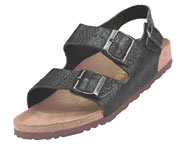
Inspect Birkenstock for unusual physical attributes. The
example used in this instruction is of the genus Classic
and species Milano. See Figure 1.1
 Step 3
Cut straps from rest of body using sharp scalpel.
Warning!: Do Not Use Excessive Force; You may cut yourself.
When this step is completed: You should have something that
looks similar to Figure 2.1.
Step 3
Cut straps from rest of body using sharp scalpel.
Warning!: Do Not Use Excessive Force; You may cut yourself.
When this step is completed: You should have something that
looks similar to Figure 2.1.
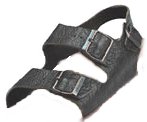 This assembly is known as "straps" It is a system of organs
composed of two leather strap sets and three (in this species)
"buckles". The straps are composed of the skin of some poor
cow that gave its life for the sake of the survival of the
Birkenstock. The buckles were formed in a high pressure forge,
a device that sucks up the world's natural resources.
Step 3
The remainder of the Birkenstock body is composed of a cork
"bed" and a rubber "outsole". The purpose of the bed is to
provide link between the Birkenstock and its wearer so that
the wearer and the sandal form a symbiotic relationship.
The bed provides protection to the wearer's feet and the feet
provide the foot-funk which is the Birkenstock's primary source
of sustenence. The outsole provides protection to the
Birkenstock. Figure 3.1 shows the bed and outsole together.
This assembly is known as "straps" It is a system of organs
composed of two leather strap sets and three (in this species)
"buckles". The straps are composed of the skin of some poor
cow that gave its life for the sake of the survival of the
Birkenstock. The buckles were formed in a high pressure forge,
a device that sucks up the world's natural resources.
Step 3
The remainder of the Birkenstock body is composed of a cork
"bed" and a rubber "outsole". The purpose of the bed is to
provide link between the Birkenstock and its wearer so that
the wearer and the sandal form a symbiotic relationship.
The bed provides protection to the wearer's feet and the feet
provide the foot-funk which is the Birkenstock's primary source
of sustenence. The outsole provides protection to the
Birkenstock. Figure 3.1 shows the bed and outsole together.
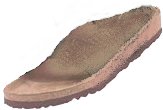 The bed is made out of cork which came from the inside of
a rare rainforest tree. The outsole is made from coagulated
Rubber-Tree blood.
Step 4
Separate the bed from the outsole using the scalpel using even
pressure. You will notice a gooey, highly viscous liquid
between these two parts. This is the Birkenstock's blood.
(Also known as adhesive.) This substance's composition is
a synthetic chemical that when manufactured, causes groundwater
pollution.
Step 5
Recycle the leftover parts properly and run from enraged wearer.
Step 6
Write up excessively long lab report.
The bed is made out of cork which came from the inside of
a rare rainforest tree. The outsole is made from coagulated
Rubber-Tree blood.
Step 4
Separate the bed from the outsole using the scalpel using even
pressure. You will notice a gooey, highly viscous liquid
between these two parts. This is the Birkenstock's blood.
(Also known as adhesive.) This substance's composition is
a synthetic chemical that when manufactured, causes groundwater
pollution.
Step 5
Recycle the leftover parts properly and run from enraged wearer.
Step 6
Write up excessively long lab report.